

Fyshh Aero
A flight training ecosystem built around the pilot, not the aircraft.
Fyshh Aero is a flight training and pilot aid ecosystem that gives student pilots, instructors and flight schools objective per-manoeuvre flight data, comparisons against reference flights flown by the school's own instructors in their own aircraft, in-flight pilot aids for safety and checklist reminders, and a written record of every ATC clearance.
The FLT app runs on the iPhone and Apple Watch you already carry, the optional COM and POD devices add cockpit audio and sensors, the FIT app checks the pilot before the flight, and nothing is fitted to the aircraft, so it works in any club or training aeroplane from the first lesson.
FLT records the flight, COM and POD add what the aircraft never carried, and FIT checks the pilot before it starts
Training aircraft carry neither a flight data recorder nor a cockpit voice recorder, so there has been no cost-effective way for a student to see empirical data on their progression or to measure their flying against the standard their instructors set. A debrief rests on what each person remembers, and a clearance lives only in the student's short-term memory. Fyshh Aero replaces both with a record.
Fyshh Aero·FLT The app for iPhone and Apple Watch
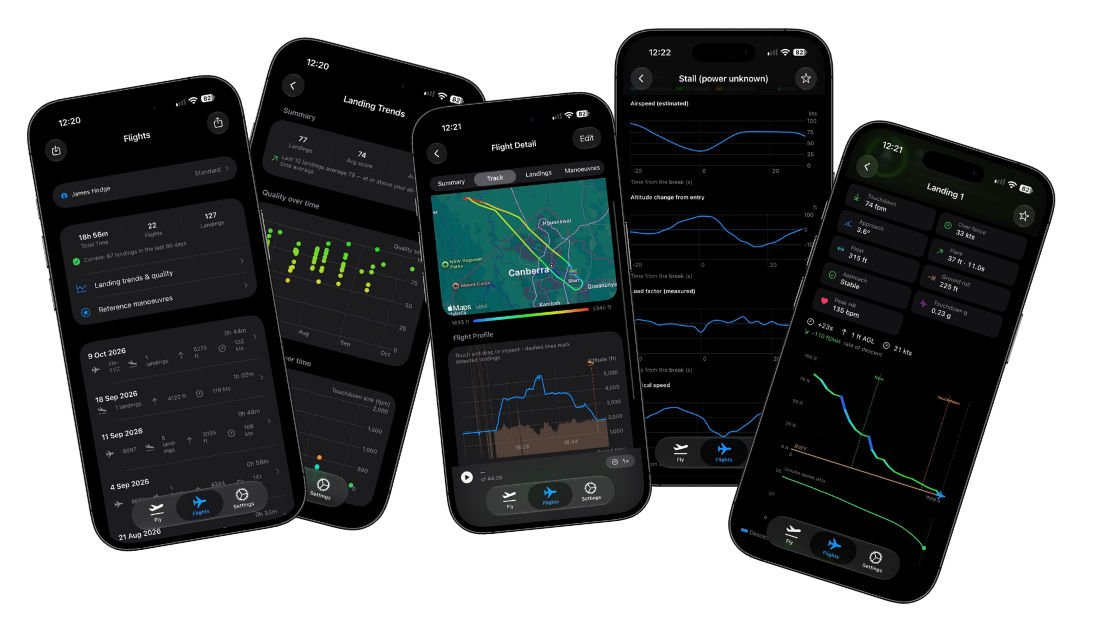
The FLT app turns the devices a pilot already carries into a flight data recorder and an objective debrief tool, capturing a complete record of the flight from taxi to shutdown.
The phone and the watch are treated as two independent flight instruments, each recording from its own GPS, barometer and accelerometer, and FLT fuses the two into one resilient record that tolerates stale samples, sensor glitches and dropped signals.
- Detects flight events automatically, from landings, touch-and-goes, bounces and go-arounds to unstable approaches, steep turns and other practice manoeuvres
- Scores every landing and turn, and compares them against reference manoeuvres flown by the school's own instructors in the same aircraft
- Haptic Morse-code taps on the wrist for fuel tank changes, cleared altitude and cleared circuit direction, without intruding on the flying
- A logbook filled from the record rather than from memory, backed up to the pilot's own iCloud
- A web dashboard for the debrief, where a shared flight opens on a 3D terrain map for the student and the instructor together, and a solo can be watched live by the school
Be part of our early testing program and download FLT for free from the iOS App Store now. Early testers receive the Standard subscription free for life when FLT is fully launched.

Fyshh Aero·COM The optional cockpit audio and sensor device
The COM device is a self-contained unit that taps into the aircraft's headphone circuit through a single cable and supplements the pilot's own devices with cockpit audio and a suite of additional sensors, reporting everything through FLT's own screens.
It draws nothing from the aircraft, modifies nothing in it and moves between aircraft as easily as a headset.
- Listens to intercom and radio, transcribes what is said, and puts a transcript of the clearances and instructions addressed to your call sign on the Apple Watch for read-back and compliance
- Updates the QNH and wind in FLT from the most recently overheard ATIS
- Adds CO and VOC detection, a higher-accuracy altimeter, motion sensors, temperature and humidity, and engine RPM from the ambient sound
- Records audio and data to on-board flash storage, giving a training aircraft the flight data and cockpit audio recorder it never had
Fyshh Aero·POD The sensor pod for the glareshield
The POD unit is the smaller, simpler counterpart of COM: the same self-contained puck with the audio left out. It mounts on the glareshield with a patch or any quarter-inch tripod mount, pairs with FLT in one tap and plugs into nothing in the aircraft.
- Measured bank and pitch from an attitude sensor fixed to the airframe, in place of estimates from the ground track
- A GPS with a sky view at five fixes a second and a barometer that is never suspended by a phone, fused with the phone's and the watch's recordings
- Shared like a headset, one per school aircraft, with the registration filled in by the school's portal
Fyshh Aero·FIT The daily IMSAFE check, on your own phone
The FIT app turns the IMSAFE self-assessment into a thirty-second daily habit, informed by the health data already on the pilot's iPhone and Apple Watch, and keeps every bit of it on the phone.
- Six letters, your own declaration: Go, Caution or Stand down, with sleep, overnight vitals, your last drink and a new medication shown beside the letter they belong to
- Learns your own patterns after fourteen days and starts each morning with an estimate, written on the phone by the on-device model of Apple Intelligence on a supported iPhone
- Nothing synced: no account needed, no iCloud, no health value ever sent to us; only the day's outcome reaches your flight record, and only if you opt in
The same record serves the student, the instructor and the school, and stays useful after the licence test
The student
A circuit sortie can hold six landings, two bounces and a go-around, and the student may only clearly remember the last one.
The FLT app counts them all, scores each approach and touchdown, and after a manoeuvres lesson overlays the student's turns on the instructor's demonstration with plain-language tips for improvement. Progress becomes a trend across lessons rather than a feeling after each one.
The instructor
Rather than trying to recall what went wrong on one landing out of a ten-circuit lesson, an instructor drills straight to the logged data for that circuit and talks through where the approach became unstable or how the flare was too harsh.
Their own demonstration, marked as a reference, becomes the standard every later student is measured against in that aircraft, and feedback on a solo flight no longer depends on asking the student how they went: the instructor can watch it live on the school portal and open the full record on a big screen for the debrief. See the web portal.
The school
Instructors fly the school's reference manoeuvres once per aircraft and the reference data becomes part of each student's standard learning materials.
That data is unique to the school's aircraft and its way of teaching, so it is a training asset the school owns and a point of difference for students comparing schools. The school sees objective progress against the reference with each lesson, spots a plateauing student earlier and can spend dual hours where the data says they are needed, with nothing fitted to the fleet.
The licensed pilot
The record keeps working after the licence.
FLT keeps currency from recorded landings, which a logbook does not always capture, and gives a pilot evidence of competency when returning to training or hiring an aircraft somewhere new.
The in-flight pilot aids matter more as flights get longer: the commonly cited 100 to 300 hour window is when complacency creeps in, and a haptic reminder to change tanks or a tap for an altitude above the clearance is useful at any experience level.
Support your growth as a pilot with the devices you already own
The debrief comes from data
Every landing and turn has a per-manoeuvre record, so the debrief is data-driven rather than anecdotal and starts from what happened rather than from what each person recalls.
The standard is the school's own
An instructor's demonstrations are captured once and applied to every student automatically, which no generic score can reproduce.
The clearance is on the wrist
With COM in the aircraft, a clearance received while turning downwind is read back from a transcript on the watch rather than from memory, filtered to the aircraft's own call sign.
The logbook is filled from the record
Engine time, landings and track are captured automatically and reproducibly, so your paper logbook can be completed from evidence rather than reconstructed afterwards.
What makes FLT unique?
The data sources are hostile and we built for that
Your iPhone and Apple Watch are powerful devices, but they're not infallable. Your watch drops GPS with the wrist down, watchOS can suspend apps for battery management purposes, and can serve minutes-old barometer samples that look fresh. The iPhone in your pocket loses satellites under the airframe, and intercom audio mixes engine noise, the instructor and the radio on one circuit.
Extracting touchdown sink rate and turn bank angle from those devices meant treating sensor integrity as a first-class problem rather than filtering noise: arbitrating between sources on every cycle, and recovering bank, airspeed and wind from the ground track alone.
Every one of our recorded test flights and landings delivers improvements in our detection and sensor algorithms that feed directly into FLT.
FLT's landing and turn scores are calibrated against recorded flights and are still being refined. We welcome feedback from our early stage testers if FLT generates summary output that differs from the reality of your flown sortie, and we'll work with you to identify the gaps and further refine our algorithms to suit your particular aircraft type or flight scenario.
Neither FLT or COM are certified recorders, instruments or a substitute for an instructor. The data from FLT helps you fill in a logbook rather than replacing one.
Get started
Download FLT today and be first in line for COM
FLT runs on iPhone with iOS 26 or later, with Apple Watch on watchOS 26 or later optional. COM early access opens to students, instructors and schools ahead of the first production run.